
How Will I Know When It Is Time?
A Compassionate Guide to End-of Life Decision Making
How will I know when it is time?
This is the question I hear most often. And it deserves a proper answer, that recognises your pet's own unique life and your families situation.
There is rarely a single obvious moment. What there is, instead, is a picture you build over time. My job is to help you build it and to help you interpret what you're seeing. Supporting you through this very challenging journey.
Even as a vet, I still struggled with this decision with my own rescue dog, Tilly. I was lucky to have vet friends to help guide me through the fog of that decision, and that experience was a huge part of the inspiration for Pet Lighthouse.
At Pet Lighthouse, we believe the answer is found by looking at the whole picture. Understanding the diagnostics and treatment options is absolutely vital, but the medical chart is only one piece of the puzzle. We must combine that clinical data with a focus on what is important to your beloved companion- their feelings, their daily joys, and their dignity.
.jpg/:/rs=w:400,cg:true,m)

Welfare is a feeling: The emotional balance sheet
Your vet's clinical picture tells you what is happening to your pet medically. But it doesn't always tell you how your pet is feeling - and that's the part that drives quality of life.
In welfare terms, every day involves a balance.
Positive experiences: e.g. pleasure, comfort, connection, interest, add to one side.
Negative ones: e.g pain, fear, nausea, frustration, take away from the other.
What matters for quality of life is where that balance sits day to day.
In a Pet Lighthouse consultation, this is where we start. We look at the full picture of your pet's daily experience, not just their diagnosis.

Fear: The silent welfare blocker
We often focus on the physical health blockers, meaning we can sometimes miss the emotional ones.
A state of chronic fear and anxiety can shut down the ability to feel curiosity or joy.
I saw this first-hand with my rescue dog, Jess; when she first arrived, her overwhelming fear made it impossible for her to learn she was safe until we utilised behavioural medication and modification techniques to help her.
A pet that is constantly hyper-vigilant is experiencing a mental health crisis that can be just as debilitating as physical illness.
A structured approach
I use the Five Domains model- the current gold standard in animal welfare science- to look at your pet's life systematically. It prevents us from fixating on one area while missing others.
- Nutrition: Is eating still a source of pleasure? Or is it a struggle against nausea, pain, or disinterest?
- Environment: Is your pet's living space comfortable and accessible for them as they are now?
- Physical health: Beyond the diagnosis, how are their health conditions actually making them feel?
- Behaviour: Can they still make choices? Move to where they want to be, engage when they want to, withdraw when they need to?
- Mental state: Taking everything above into account: what is the overall emotional experience of their hour, day and week?
This structure gives us a clear map rather than a general sense of your pet's wellbeing.
.png/:/rs=w:400,cg:true,m)
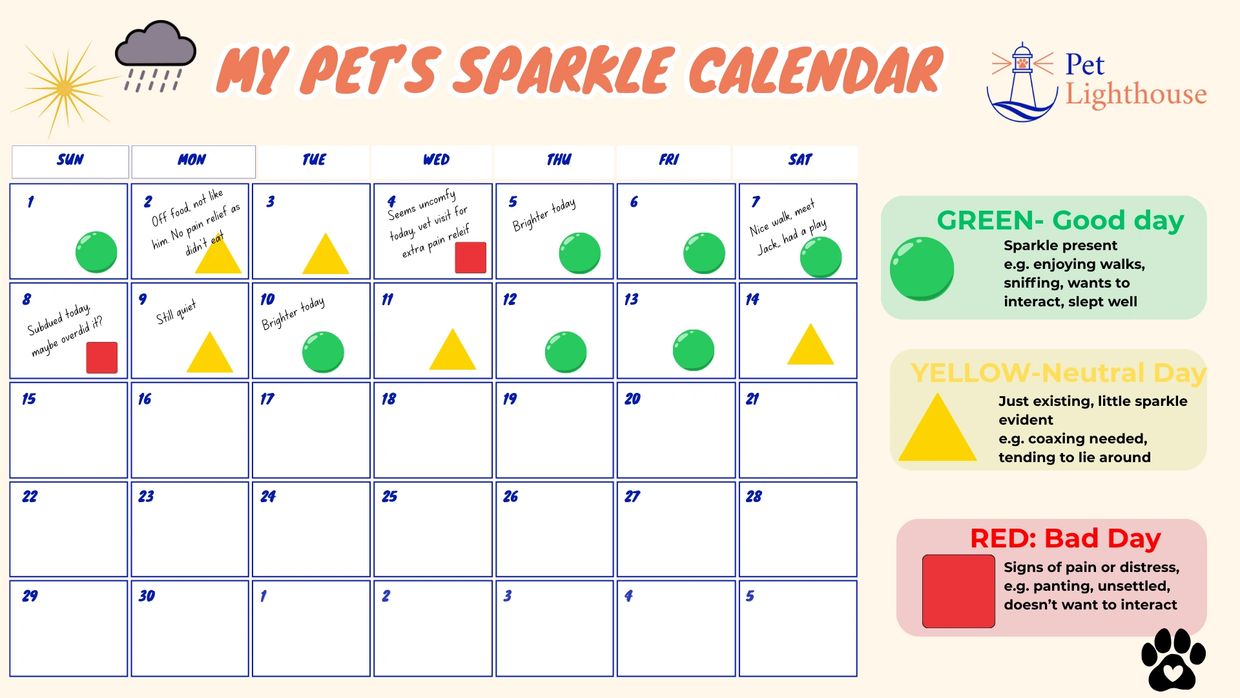
Monitoring the sparkle: Moving from guesswork to data
Our memories are biased by hope. A run of difficult days can be softened in our minds by one good afternoon. Systematic monitoring helps cut through that.
To answer "how will I know?", it is very helpful to move towards some sort of daily monitoring of how you pet feels.
Practical options:
- A sparkle log — identify 3–5 specific behaviours that tell you your pet is doing well. Track when they appear and when they don't. Note whether they can be replaced with alternatives as ability changes.
- The calendar method — mark each day green (good), yellow (neutral), or red (difficult). When red appears regularly, or yellow becomes the permanent baseline, that's meaningful data.
- Condition-specific tracking — for some diagnoses, validated tools exist to monitor relevant symptoms. Pet Lighthouse can point you to the right ones, or help you design a simple personalised version.
In a consultation, I can help you set up a monitoring approach that makes sense for your pet's specific situation.

The power of a plan: Reducing distress through preparation
Research is consistent on this: families who have a plan in place experience significantly less distress when the time comes.
Things worth deciding in advance:
- Who needs to be present
- Whether you want to be at home or at the clinic
- Your out-of-hours contact, saved in your phone
- Aftercare arrangements (cremation or burial)
None of this commits you to anything. It simply means that when you need to act, you can focus entirely on your pet, not on logistics.
Navigating the guilt trap
Almost every owner I speak to fears getting the timing wrong. That fear is real and it's normal.
This weight is often intensified by anticipatory grief - the painful process of mourning your pet while they are still with you. It is vital that you are kind to yourself as you navigate this.
If you choose to act while they still have some good moments left, you are protecting them from what's coming , preventing a crisis, preserving their dignity.
If you're still uncertain, it's worth sitting with this: animals live entirely in the present. They don't mourn the time they didn't get. The experience they are having right now is the only one that matters to them.
There is no perfect day. What there is, is a careful, honest assessment of where the balance sits and a decision made with full information and genuine love.